A Gaggle of Cun….

It seems that barely a week is able to pass by without an underclass of social media users sharing images of something disgusting.  This week’s image in question, which incidentally, I am not going to share, is of a dead Syrian child lying on a beach.  It is an image so repugnant in its very idea, that there is absolutely no need for anyone to ever share it.  Unless they are morally obtuse, self-absorbed, shitbergs.

This social media underclass of keyboard warriors and online campaigners believe that they are making a difference.  In my own encounters with these feckless morons the most common defence that I have encountered is that they are, in fact, ‘raising awareness’.  In this particular case they might be right.  There might be someone, probably called George, that lives in a closet, has an allergy to news, and has only one friend in the entire universe responsible for shaping their world view.  Them.  In such cases it is indeed true they are raising awareness, raising awareness that George should likely try living a life in the real world.  However, putting George to one side for a moment, I cannot help but wonder what it is precisely that they are raising awareness of?  Death?  Their penchant for collecting pictures of dead children?  The fact that life is unfair?  That war is fatal?

The fact is, these click-baited mindless morons gain a sense of usefulness and righteousness from their actions.  They are honestly that stupid that they believe with a genuine conviction that sharing distressing images does something positive for the causes which they care about.  That all they are required to do is click one button, or touch one screen and life will become inordinately better.  It is self-delusion of a scale that in past centuries would have landed them inside mental asylums, and yet, today, is the true epoch of our modern age.

The saddest thing of all is that this sharing, caring, generation of internet zombies are, deep down, exactly the same as George.  They are all blithely unaware of the universe which lives outside of their own doorsteps.  It is as if the genius of Zuckerberg is that he has convinced us that we are regal in our kingdoms.  That we Gods of the touchscreens are able to shape the perceptions of others through tacit use of shock and awe.  That humanity is a community interconnected by screens.  It is not.  It is a living, breathing dying gaggle of gene machines.  Humanity cannot be saved by the power of want.  The force of intention does not put food in the bellies of refugees.  The awe of image cannot stop wars.  The divine power of the share button cannot stop people dying, no matter how many times you share a photograph of a dead child on a beach.
Labels

Once upon a time there was a language in which words had meaning.  And then came the devil Ambiguity, along with his minions, Politics and Religion.  From that moment forth, meaning became as cloudy as a shower of piss.

When contentious events unfold, anywhere in the world, there is a scramble to gain control of the narrative.  It is commonplace for businesses, governments and individuals on occasion to hire people to manage the flow of information and colour it appropriately to try to morph the story into a predefined version.  This behavior affects all forms of media, stretching from newspapers and magazines, all the way down to simple memes which people share online.

One of the key strategies in public misdirection is the inappropriate use of labels.  When a news story becomes attached to sometimes a single word, or a single idea, the public’s attention is driven away from considering what truly happened and instead the public become recipients of a ‘manufactured’ intrepretation.  A recent example is the shooting in Paris.

For those of you that have been hidden under a rock for the past week, two gunmen entered the office of a satirical magazine and murdered a number of people.  Various ‘labels’ for the shooters were flung around in the beginning such as ‘terrorists’, ‘extremists’ and ‘Islamists’, before they were quickly replaced by an ideology so important to Western European societies that almost immediately the crux of the problem was forgotten.  At some point it stopped being a terrorist attack, we were all mistaken, it was in fact an attack on free speech.  Except that it wasn’t.

There are always few bare facts in a story.  In this case the one fact that is crystal clear – a satirical magazine was attacked for cartoons which satirized Islam.  It was not the office of journalists without borders.  It wasn’t an association against censorship.  It was a targeted attack against one magazine.  To claim that this attack has anything to do with free speech makes as much sense as blaming it on cheese, or blaming it on religion.

In France there are an estimated 4.7 million Muslims.  There were three gunmen involved in this spate of attacks.  If by any chance this was genuinely caused by religious beliefs the result would have been significantly different.  And yet there were no riots or large-scale protests like we’ve seen in the past.  There is only one conclusion any rational person can draw from this.  What is the label that adequately describes men such as these, that purposely acquire weapons so they can murder people who create cartoons?  Mentally ill, perhaps?

Last weekend people marched in solidarity and didn’t really seem to know why.  They felt the very human urge to say that they are not scared, that they believe in free speech and that violence will never win.  Despite the fact they weren’t really sure of what they should be afraid of, nor were they sure of what precisely free speech is or who is threatening it.  The important thing is that ordinary people marched arm in arm with the free-speech (not so) loving leaders of the free world to send a message.  And the message was thus ‘we are blind’.

This ‘wave of feeling’ which has ridden across the western world is not going to be a catalyst for change.  Therefore it is meaningless.  The idea that doing absolutely nothing is going to stop further terror attacks is absolutely mental.  If anything they will only increase, as every single example only further demonstrates what sitting ducks we all are.  The worst thing is that whilst we all focus on the European narrative, while we raise our pens and proclaim ‘Je suis Charlie’, little by little our freedoms and our rights are going to be stolen from us piece by piece.

How Many Fingers Am I Holding Up?

On either side of your body, starting somewhere(hopefully) by your shoulders are a set of bones which you most likely know as your arms.  At the ends of your arms, are five pointy collections of bones which you will probably refer to as your fingers.  If you do, you are wrong.  Not wrong as in incorrect, but wrong is absolutely, unequivocally, unquestionably entirely NOT RIGHT.  It is quite possible that I have never ever met you.  It is likely that I have never even seen a photograph of  either one of your limbs.  Yet somehow, I can say with utter certainty that you have absolutely no idea about what is happening at the ends of either of your arms.

Picture the scene – it’s a crap day.  It is raining, the sky is greyer than a monk’s underpants.  It is lunchtime at a Primary School.  There are dozens of children filling a miserable concrete playground with enough kinetic energy to propel a small rodent to Saturn.  Two young boys get in an argument about a bench.  Although some other kids see parts of it, nobody sees all of it.  When the kids go home that evening the first boy tells his Mum that he was bullied.  The second boy tells his Dad that he got in a fight.  Nobody saw either boy strike the other, yet there were many witnesses to the first boy pushing the second.  Was it a fight?  Was it bullying?  Who was the winner?  Who was the victim?  How is possible that two small children that cannot possibly grasp the concept of advantageous lying  somehow do?  What if the first child is an only child?  What if the second child has two big brothers?  Who was right?  Who was wrong?

There are three conclusion we can draw from the tale of the two boys.  The first is that there is no such thing as a single truth.  The truth is pliable to the facts which weigh upon it.  The second is that our truth changes shape to accommodate any information we gain access to.  There isn’t such a thing as a certain truth, a pure truth that can never ever change.  The third is that a snapshot of a moment is so extremely misleading that only a fool would believe that they are privy to the whole story when they have only caught a glimpse of the truth.  If these conclusions are indeed valid why is it that so many people share images that have no other purpose than to shock, often alongside a hastily assembled slogan intended to draw a sense of guilt for a single event that took place within the myriad of  atrocities that are being carried out in the countless number of active war zones around the world?  Are we really that much more foolish online than in the real world?

There is an easy way to test this.  Extend your arms in front of you.  Now extend your fingers.  Now count them.  How many fingers are you holding up?  The answer dear friends, is eight.  And you can’t argue with that.  After all, it’s reality, isn’t it?

#MyRoadtoSochi

#Sochi.  A city of over 300,000 residents. #Sochi one of the very few places in Russia with a subtropical climate.  #Sochi the home of the Winter Olympics in 2014.  Which of these three statements is the most surreal?  Which of these three statements seems the most unbelievable?  Which of these statements are true?

My #Sochi is not any of those.  My #Sochi is a moment.  A moment of realisation.  An epiphany if you will.  It is the sudden realisation that if you don’t fucking like something, do something, anything.  Because at the end of the day the only thing which truly matters in life is exactly how you feel about yourself.

My #Sochi moment happened in a supermarket.  I was standing in the crisp aisle looking for something to accompany the crate of beer which lives on my balcony.  My eyes fell upon a packet of barbecue Pringles.  As I reached onto the shelf to take the packet my arm refused to obey me.  My brain found a picture in the dusty recesses of my mind.  It was a picture of #Sochi sponsors.  I stood prostrate by choice, suddenly feeling guilt that I was considering buying a packet of Pringles.  As I stood there my mind started to race, and I found myself asking what difference a few euros would make to a brand as powerful as Pringles.  I knew the answer instantly, none.  And yet I remained glued to the floor.  Suddenly it dawned on me that it wasn’t the gesture that was empty.    It was my perspective which was faulty.  The moment wasn’t momentous because it represented a politicization of me.  It was momentous because it was the moment I truly learned the power of social media, that sharing can penetrate people’s consciousness.  And most of all I realised that it is a battle which can be fought.  The emptiness of the gesture suddenly dissipated like a puff of smoke.  I picked up a bag of Croky, stuck my fingers up at the Italian looking Pringles face, span on my heels and left with a giggle.

The trouble with perceptions is that they are often wrong.  In my case Mr Pringles is innocent.  He is not a sponsor of the Sochi  Olympiad.  My mistake was that I had taken a picture that I believed to be true, and created my own set of assumptions based upon the image.  In much the same way that people are instinctively believing the numerous images posted by American journalists on social media, showing various building calamities in Sochi are all true, I had fucked up; I had put faith in an image.  When you think about it you know they can’t be.  If the President of Russia, members of his government, and the members of the Olympic Committee say that #Sochi is ready, who are we to think otherwise?

The curious thing is that it reminded me of a novel I wrote back in 2010, which incidentally remains unpublished.  It tells the story of a dictator in a fictional African country that changes reality in his country.  The dictator rules his country under the assumption that he is the country.  There are more than a few similarities to a large country somewhere to the east of me, as well as a number of others.   The saddest thing of all is that even today it is possible for a statesman to change the reality of his people by proxy.  If a statesman wants to build a winter sports facility in a subtropical climate, why shouldn’t he?  If a statesman wants to host an international event just a few hundred miles from a number of terrorist hotbeds and declare it safe, why shouldn’t he?  If a statesman wants to outlaw educating people to prevent them turning into homosexuals, why shouldn’t he?  After all if he has the faith of his people, surely we should not question him.  Should we?

The most depressing fact of all is that these issues have corroded my own reality.  I have become the type of hypocrite I resent.  I decided weeks ago that I will not watch these Winter Olympics.  And yet there is a hunger inside of me.  I have spent hours reading countless articles about the games.  I have reveled in a thousand Buzzfeeds showing how the Sochi Olympics are proving to be an unmitigated disaster.  I am denying my own reality.  I am not abstaining from the 2014 Winter Olympiad at all.   Instead, I am a voyeur, peering through a window even though the curtains are closed.

If I have learned anything at all about #MyRoadtoSochi it is this: We are entering the last battle in the age of indifference, the battle for reality.  It will require a little effort from each of us.  It will require learning.  And it will require speaking out against those people hellbent on bending it into unrecognizable shapes.

Emancipate yourselves from mental slavery;

None but ourselves can free our minds.

Bob Marley

The Age of Indifference

Hardly a day goes by without something horrifying happening somewhere.  It is impossible to turn on the television, or surf the internet without catching a glimpse that something god awful has happened somewhere.  The image driven way in which we live means that we have been utterly desensitized to what we are seeing.  It has no resonance.  It creates no fear.  As by and large it is so far away that we need not give it a second thought.

Restitution, penance or whatever the hell you want to call it is a queer old bird.  In the heyday of global awareness people used to do all manner of strange things to raise money for causes close to their hearts, nowadays, when the entire universe is a single click away, the most most people ever do is like or share a status on Facebook.  They sleep easy feeling that they have pinned their colours to the mast, that they have done their bit, that they have changed or affected something.  And it makes me sick.

We are now living in the age of indifference, protected by the castle battlements which are the screens we use to communicate with each other, even when we are sitting next to each other on the bus, or at the dining table.  It is an age in which people have truly lost the sense of their very selves, as these tiny screens provide people with a sense of safety which real life could never offer.  The fact is that we now spend so much time staring at screens the vast majority of us are entirely unable to separate fact from fiction.  It’s as if our indifference has made us imbeciles.

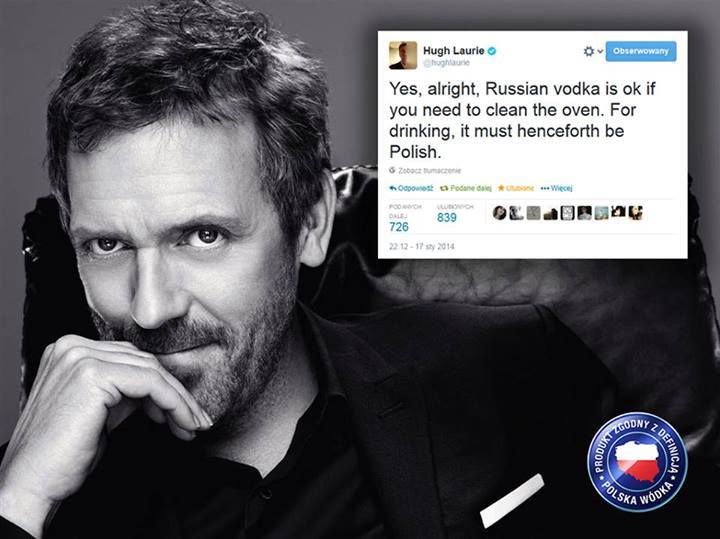
A great example of the stupidity of people appeared on social media this weekend.  On first impression it appears that this is an advert.  It looks as if Hugh Laurie is promoting Polish vodka, which is quite a reasonable supposition. hughlaurieAfter all it is stamped with a Polish vodka label.  A media agency took the quote directly from Hugh Laurie’s twitter feed, stuck it onto the picture with the label and suddenly one simple tweet had become a marketing campaign.  Many patriotic Poles proudly shared this picture without giving it a second thought.  Why would they?  After all, if it is on twitter it must be real, right?

What if you took a peek on Twitter and merely looked at Hugh Laurie’s previous tweet?

Would it change a thing?

And what if you really went wild, and err took the time to look at the tweet before that?

Suddenly the entire context of that single image has taken on an entirely different meaning.  It was not a tweet promoting Polish vodka.  It is not from an advertising campaign.  It was a complaint, a reaction to Russia’s draconian persecution of gay people.  It was a point worth applauding, worth celebrating which unfortunately was manipulated for an entirely different purpose.

It is a sad example of what we have become.  It should have been a rallying cry for people to stop and think about Sochi.  To think about the persecution of gay people which is taking in place in Russia today.  Now today.  It could have been used to encourage people to boycott Russian products.  To boycott Sochi sponsors products.  To not turn on their televisions to watch the Winter Olympics.  Instead it became a Facebook viral hit.  Welcome to 2014. Please leave your brains at the door and prepare for take off.